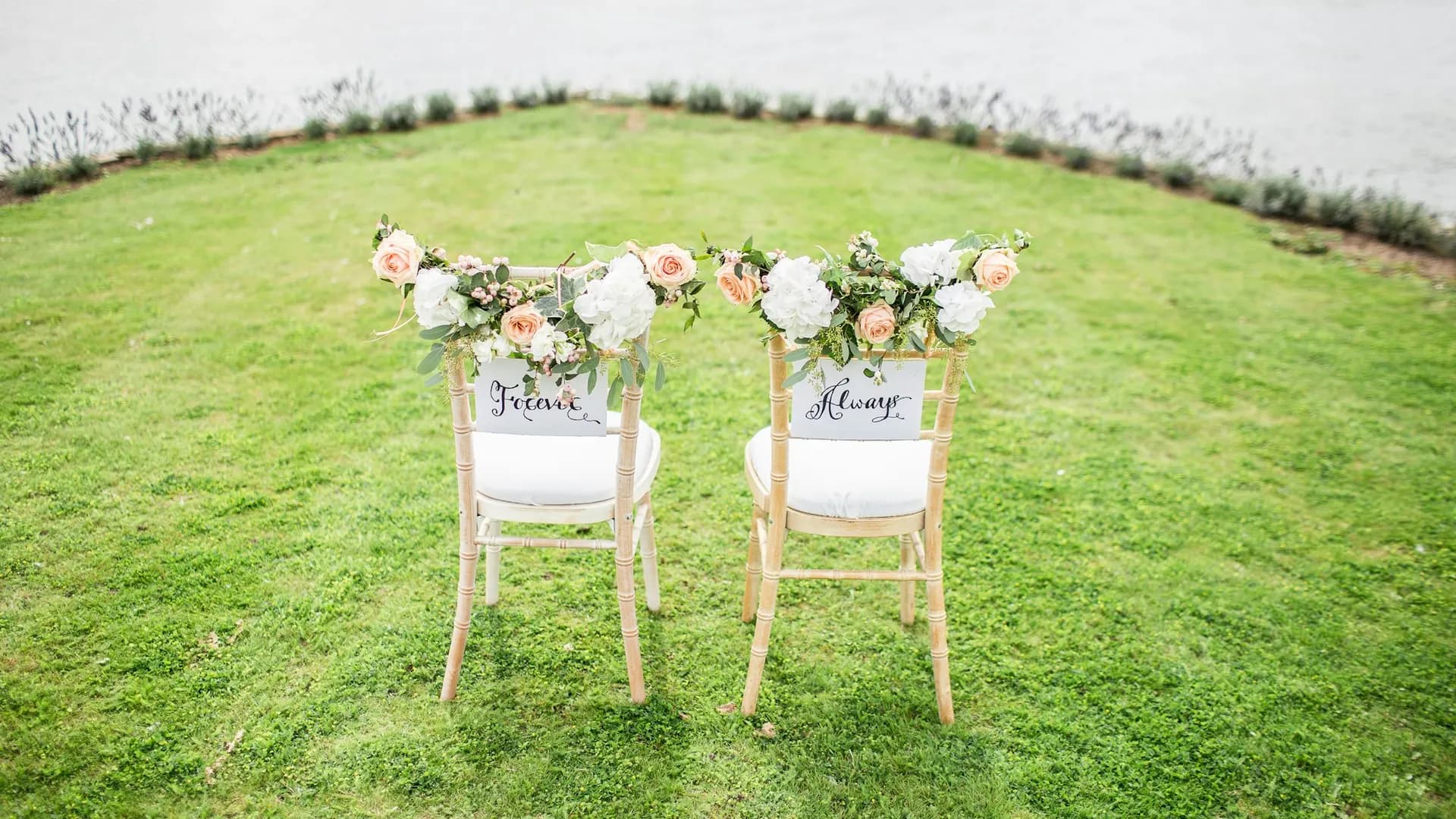
A vineyard is already a designed landscape. Rows, posts, and a long horizon do more work than a ballroom’s blank wall. Florists who have not been given site notes will try to compete with that, usually by building up. Wind then files an objection.
The flowers hub has the question list you can paste into an email. This note is how to write that first email so the reply is about mechanics, not adjectives. If you only send a colour code and a city hall picture, you have asked for a fight with the site.
What the first email is for
The first email is not a mood board. It is a site packet. Its job is to let a florist decide whether they can work the ground, the wind, the water, and the clock. A useful reply names what holds an arch down, who installs it, where water lives, and what happens if the ceremony moves indoors. A thin reply says it will be beautiful. Write again if you get the thin one.
Send the packet before you ask for a look. Looks without a site become sculptures that cannot stand on a lawn. The valley is not a studio: irrigation, gravel, slope, and afternoon wind are part of the design whether you mention them or not.
If two people are writing to florists, use one packet. Mixed instructions waste a week and produce two quotes for two different days.
Walk the site as if you were installing, not posing
On a recce, photograph the unglamorous axis, not only the pretty one. Stand where the couple will stand and turn a slow circle. Take the view guests will have behind the vows, the view a photographer will have into the sun, and the view toward the indoor backup. Include a person or a chair in at least one frame so scale is honest.
Then photograph the ground. Grass that looks velvet in a wide shot can hide a camber, a wet patch, or a recently watered run. Photograph the posts, the guy ropes, the hose points, and any sign that says where stakes or flame are refused. Photograph the path ceremony pieces would travel if they must move to dinner — door widths, steps, gravel, and the room they would land in.
Write three sentences while you are still on site:
- Where the sun is at the ceremony minute, as best you can tell.
- Where wind usually comes from, or that you do not know and need the property to say.
- What happens to the lawn after a night of rain.
Those three sentences are worth more than a folder of reception tables from another country.
Build a packet the florist can work from
Attach, in this order:
- The ceremony pin and the indoor backup, with photos of both
- Guest number as a range, and table shape (long feast, rounds, a mix)
- The minute the ceremony must start, and whether that minute is fixed by a celebrant or a licence
- Whether pieces must travel to dinner, and who is free to move them
- Property rules on petals, stakes, water, vehicles on the lawn, and open flame
- How personal flowers get from the getting-ready room to the lawn — minutes in a car, and whether that car has shade
- A short note on scent: anyone who cannot sit near heavy perfume or lilies
Then, and only then, a handful of images that show scale and looseness you like. If every image is a hanging installation in a sealed hall, you are asking the florist to invent a different site. Prefer pictures with visible sky, visible posts, and flowers that still look alive in daylight.
You do not need a brand name on the packet. You need the ground.
Ask for mechanics in the reply
Write the questions so a yes/no is impossible. You want to know:
- What holds the arch or meadow stand down on this soil, and what the property allows
- Where water lives during the day, and who refills it
- Who installs, who packs down, and how long each job takes
- What happens to personal flowers between portraits and speeches
- Which pieces are designed to move, and which are not
- What the florist will do if the lawn is refused that morning
If the reply is only “it will be beautiful”, you do not yet have a plan. A second email that repeats the mechanics list is not rude. It is how you avoid a Saturday argument.
Ask who is on site at the ceremony minute. A studio that delivers and leaves is a different product to a studio that stays through the move. Neither is wrong. They are different, and your run sheet must match the one you hired.
Wind, height, and the temptation to build up
Vine rows make a wind tunnel even on a mild day. Height that looks romantic in a still room becomes a sail. The fix is not “more floral foam and hope”. The fix is a lower centre of gravity, a wider base, and a florist who has been told the axis is open.
Tell them which direction the vows face. Tell them if a row of posts will stand behind the couple. Tell them if you want the horizon visible in photographs — because dense height will steal it. The photography hub is the place to decide whether vines should stay in frame. The florist should hear that decision, not discover it when the arch lands.
Aisle pots that sit on the ground usually behave better than an aisle of tall stems. Hanging pieces need a structure the property has approved. If no structure exists, do not invent one in an email to a florist who has never been to the gate.
Heat, cars, and personal flowers
A Yarra Valley lawn in summer is not a florist’s cool room. Buttonholes in a warm car for an hour will tell on you in the photographs. Bouquets left on a verandah rail in full sun will tell on you at speeches.
Name the getting-ready address and the drive time to the lawn. Ask where personal flowers wait: a shaded room, a cooler, a person whose only job is to carry them. If the getting-ready cottage is twenty minutes from the ceremony, that drive is part of the floral design.
Corsages and flower crowns need the same sentence. Anything worn on skin in heat needs a water and shade plan. If you do not want to manage that, choose simpler personal flowers and spend the care on the ceremony axis.
Winter has the opposite problem: people in coats will crush a wide bouquet, and cold hands will not hold a wet stem happily through a long outdoor greeting. Ask for a shape that can sit on a chair during the legal signing without dying.
Ceremony pieces and table work are different jobs
An arch, a pair of pots, and a meadow-style stand are architecture. They have weight, wind, and a pack-down. Table work is hospitality: people must see across it, speak across it, and not wear the vase home on a sleeve.
Do not ask the same object to do both jobs unless someone owns the move. A ceremony meadow that becomes a reception backdrop can work if it is built to travel and if speeches do not start the moment guests sit. A ceremony meadow that is still being carried while guests look for place cards is a jam.
Long tables want a lower line than rounds. Rounds can take a little more height in the centre if the room is tall and the air is still. Outdoors, keep the line low enough that faces stay visible. Candles and flowers share a table only if the property allows flame and if the florist has planned drip and wind.
Negative space on a table is not a lack of budget. It is how glasses, menus, and elbows still fit. The hire conversation gets quieter when the florist has already claimed the centre line.
The move needs a named human
If ceremony flowers will travel to dinner, write a name on the run sheet who is not also required in a family photograph. Timing is part of the design. The celebrant, the photographer, and the venue will not pause a Saturday because an arch is still on the lawn.
Ask how long the move takes with the actual pieces, not with a hopeful version. Ask whether a vehicle can reach both ends. Ask who sweeps petals if the property forbids them on the next lawn.
If nobody is free to move flowers, do not plan a move. Design a ceremony that can stay, and a reception that can start without it. Two smaller plans beat one elegant plan that needs a ghost.
Leave some of the valley alone
Not every post needs a posy. Not every row needs a garland. The vines, the posts, and the sky are already doing compositional work. Florists who have not been told that will fill the gaps because empty space photographs as a mistake in a city room. Here it photographs as the reason you booked the valley.
A smaller amount of living material, well watered and well placed, usually reads as calmer — and more expensive — than a truck of product in the wrong wind. This site will not invent the invoice. It will tell you that restraint is a design choice, not a consolation.
Walk the axis with your photographer’s frame in mind. If the picture you want is rows receding to a hill, do not put a dense wall of blooms where the rows begin. If the picture you want is a close vow with a soft hedge behind, the florist can work smaller and closer.
Gums, herbs, and vineyard foliage can be part of the language if the property allows cutting or if the florist brings similar texture. Do not strip a working vineyard. Ask what may be used, and treat “no” as a specification.
Water, installation, and the end of the night
Living flowers are a hospitality shift. They need water at delivery, at the ceremony, and at the reception if they last into speeches. Ask where buckets can stand that guests will not kick. Ask whether the kitchen or the cellar-door team will tolerate a florist’s corner for an hour.
Installation windows matter. A lawn that is still being set with chairs cannot take an arch. A cellar door that opens to the public until a certain hour cannot take table work until that hour. Put the florist on the same clock as the venue’s exclusive-use time.
Pack-down is the part couples forget because they are dancing or gone. Who takes the arch apart. Where rubbish goes. Whether vessels stay overnight. Whether a Monday collection is allowed. Write it. A Saturday that ends with vessels in a car park is a Monday problem for someone you like.
How to read the reply you get
A useful reply mentions the site, the month, and at least one constraint you sent. It may decline a picture you attached, and that decline is information: the florist is working the valley, not a Pinterest folder. It should say what they will not do — hanging pieces without a structure, petals on a banned lawn, a move with no hands.
A reply that could have been sent to any wedding in any postcode is not yet a plan. You can still hire that studio if you like the work, but you must then write the site mechanics yourself and get them confirmed.
If two florists answer the same packet, compare mechanics before you compare adjectives. The one who asks about wind and water has read the day.
A sample first email, without a colour lecture
You can copy this and replace the brackets:
We are marrying at a Yarra Valley vineyard setting in [month]. Ceremony on the lawn at [time], indoor backup is [room]. About [number] guests. Tables will be [long / rounds].
Attached: photos of the ceremony axis, the backup room, and the path between them. Property notes on stakes, petals and flame are in the same file.
Please tell us what you would install, what holds it down, who is on site, whether ceremony pieces can move to dinner, and what personal flowers need for a [X]-minute drive from the getting-ready room.
We want the vines visible in photographs. We would rather do less, well watered, than fill every post.
That is enough to start. The flowers hub has more questions if the reply is promising. The planning guide is where this email sits in the year: after the setting is real, before you argue about napkin tone.
Mistakes that waste a week
Sending twenty images and no site photos. Asking for a hanging meadow on a lawn with no approved structure. Assuming the florist will also be the person who moves the arch. Leaving buttonholes in a car because “it is only twenty minutes”. Treating irrigation as the venue’s surprise instead of a question. Filling every table so thoroughly that glasses have no home. Writing “rustic” and hoping it means the same thing to two people.
Another quiet mistake: hiring from a memory of a listing you cannot verify. Confirm the studio yourself. This journal will not name one.
After the flowers are decided
Once mechanics are written, the rest of the décor conversation should shrink. Hire pieces can support the florist instead of competing. The photographer can be told what will move and when. The celebrant can be told whether an arch will still be there for the legal signing.
Keep the florist’s one-page note next to the run sheet. If the weather turns, you want one document that says which pieces come inside and who carries them. That is the point of writing a careful first email: not to sound like a planner, but to arrive at Saturday with fewer live questions.
When the florist notes are honest, the valley can stay in the pictures. That is the whole job.